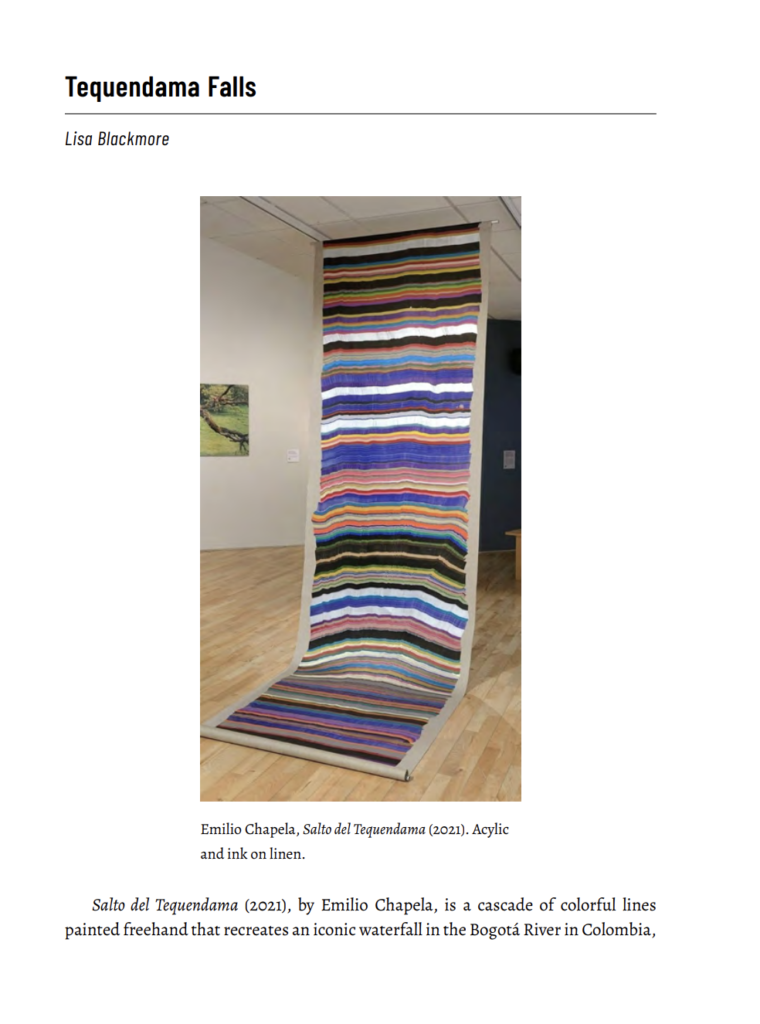
Happy that this text which combines an analysis of Salto del Tequendama (2021), by Emilio Chapela, with some cultural history of the Bogotá River, is now out. Tequendama Falls is a breathtaking body of water, a cascade of more than 150 meters that tumbles over a precipice.
Emilio and I have been in collaboration since 2019, bonded by our common interests in the lives of rivers, their communities, infrastructures, and material-aesthetic forms.
As well as connecting us with the contemporary crisis of the Tequendama Falls, on the polluted Bogotá River, Chapela’s work connects with a rich visual archive that charts the transformation of this river, from the Mhuysca’s occupation of the watershed to modernization and industrialization processes.
Salto del Tequendama was developed as part of Emilio’s aesthetic and theoretical exploration of the lives of rivers as they interact with the dynamics of human development. It was part of the co-curated program we ran together with Diego Chocano, now curator at the Barbican in London, when entre-ríos’ projects were forced online during the Covid-19 pandemic.
During that period, with a group of artists, scientists, scholars, and activists, we asked how remote channels -digital, embodied, aesthetic- would enable us to connect to bodies of water even from a distance. That collective inquiry resulted in the curatorial Channels we created for entre-rios.net
Visual Representations – Handbook of the Anthropocene in Latin America VI
Edited by Gerardo Cham, Juan Arturo Camacho Becerra, Olaf Kaltmeier, and Elissa Rashkin
Bielefeld University Press
Throughout the history of the Americas, sentiments toward the environment have been problematized and aestheticized through visual representations in various formats.
In this volume of the Handbook The Anthropocene as Multiple Crisis, sixty entries examine the crises of mining, energy, land use, biodiversity, water, and climate change in the major macro-regions of Latin America from the colonial period to the contemporary era of the Anthropocene, featuring iconic images from this context.
The book is available open access online. Click here to download the PDF.