How do we know whether our curatorial methodologies generate change among participants?
The processes developed by entre—ríos often emerge from university contexts. In both research and publishing, academic timelines can move at a slow metabolic pace. Over the past three years, with Laura Giraldo-Martínez, Diego Piñeros García, Juliana Steiner, we have been developing curatorial actions that restore connections with the Bogotá River watershed. As we advance this work, it is important to engage in reflective practice to assess how project pathways align to objectives, what went well and what challenges emerged.
With Laura and Carolina Neu, we just published an article that addresses this question by examining how people can rebuild relationships with damaged rivers by learning and acting together in the context of RÍO BOGOTÁ, our project bringing researchers, artists, and river caretakers together around Colombia’s heavily polluted Bogotá River. As part of her PhD within the River Commons project, Laura and Caro co-designed a consultation methodology involving collaborators we’ve been working with over the past few years watershed.
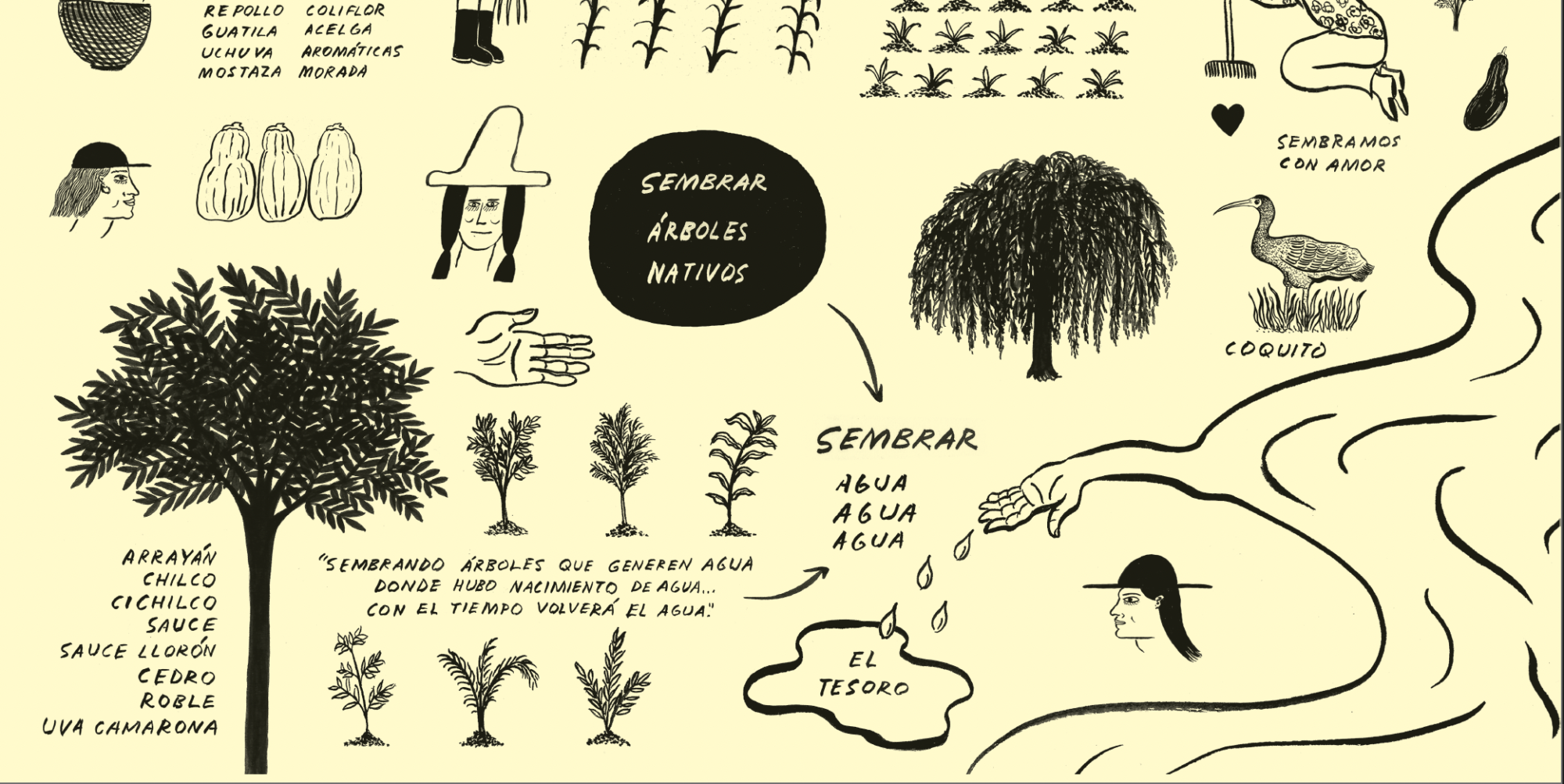
Grounded in theory of change literature and practice, and geared toward evaluating specific project objectives and methodologies, the assessment methodology comprised interviews and focus groups to trace transformations occurring at different scales. “Commoning a ‘dead’ river” focuses on the curatorial methodologies and theoretical frameworks behind the Piquete del río Bogotá (2023), the publication Cómo cuidar un río (2023), and the series of workshops that Laura led in 2024 with RÍO BOGOTÁ collaborators across Bibliored, Bogotá’s public library network.
Drawing on interviews and group discussions, our article sets out why these activities matter, how they helped participants share knowledge, strengthen connections, identify as river dwellers, and build networks for collective care and action. Ultimately, this research contributes to hydrocommoning practices occurring in degraded watersheds and water ecologies across the world, offering insights into processes of doing work at the intersection of environmental humanities, political ecology, and curating. We contend that restoring degraded rivers requires not only environmental interventions, but also stronger relationships, shared knowledge, and sustained collective action that ignite our imaginations.
The article is part of the dossier Transdisciplinary Research around Latin American Commons: Exploring Tools and Methods, edited by Emilie Dupuits and Luisa Galindo. We invite you to read and download it here.